
Research Projects
PRP & Tendon Project
Join the world’s largest real-world PRP & Tendon study.
Be part of an international, multicenter, scientifically-driven project to transform clinical practice into solid evidence.
Over 3,000 patients
100+ international centers
Be part of the solution
the scientific challenge
Why this matters
Chronic tendinopathies affect millions worldwide, but PRP treatments are still ahead of the evidence:
- Protocols vary widely
- Product characterization inconsistent
- Follow-up rarely standardized
This project seeks to turn today’s heterogeneous practice into a global, data-driven standard.
Application areas
Patellar Tendinopathy, Achilles Tendinopathy, Epicondylitis, Plantar Fasciitis
Study Highlights
- The largest Real-World PRP Study ever conducted
- 100+ centers worldwide
- 3,000+ patients
- Real clinical practice
- Minimal disruption to daily workflow
Study pillars
Real World Evidence, PRP Characterization, Artificial Intelligence.
Clinical Promoter
Dr. Ferrán Abat
Medical Director, ReSport Clinic (Barcelona, Spain). Internationalauthority in PRP and tendinopathies, with extensive multicenter research experience, 100+ peer-reviewed publications, and active participation in scientific societies and international guidelines.
Participation
Your Participation
Easy, Valuable, Impactful
Continue treating patients normally Register each case in less than 4 minutes with BioSmartData. Secure, encrypted, ethically validated data Independent, non-commercial study Opportunities for co-authorship and scientific visibility
Apply as Investigating Center
Clinical kickoff: July 2025
CHRONIC PAIN PROJECT GOIB-PINEM23
THE SCIENTIFIC CHALLENGE
Chronic pain affects nearly 1 in 4 adults, with an average duration of more than 6 years. It leads to repeated procedures, long-term medication exposure, mental health impact (depression and anxiety are reported in over 20% of patients with chronic pain), and a high use of healthcare resources — primary care, pain units, emergency services, imaging, interventions.
Despite this burden, most of the clinical information generated in routine care is never analyzed, never shared, and never used to improve decision-making.
We are changing that.
MAIN Objectives
Define MICP consensus; conduct first national RWE study in chronic pain; create interdisciplinary protocols; understand national situation; optimize existing treatments; develop AI predictive models.
Specific Objectives
Long-term safety evaluation; identify key variables; empower patients; measure clinical efficiency; support new techniques.
phases
Delphi consensus indicators, AI model development, validation with real data,
implementation and clinical trial.
Featured Scientific Publication From Consensus to Real-World Clinical Evidence
Our multicenter project has delivered its first scientific result: a national consensus defining the Optimal Information for Chronic Pain (OICP) — a standardized set of clinical variables to assess chronic pain patients in real-world clinical settings.
Title
Optimal Information for Chronic Pain (OICP): Delphi Consensus on Patient Assessment and Interventional Techniques
Journal of Pain Research (2025)

Summary
This study, developed with the participation of more than 50 specialists across Spain, defines for the first time a minimum clinical dataset for chronic pain patients, covering three major domains: patient/pathology, treatment, and follow-up.
The consensus provides a common foundation for standardized data collection, inter-center comparison, and the development of Real-World Evidence (RWE) and artificial intelligence–based analysis models.
BioSmartData contributed to the technical deployment of the Delphi platform and the coordination of survey dissemination, without participating in study design, data analysis, interpretation of findings, or manuscript writing.

Co-funding and Acknowledgments: This project is co-funded by the European Regional Development Fund (ERDF/FEDER) and the Sustainable Tourism Tax of the Balearic Islands (ITS). “A way to make Europe.” Duration: 2023–2025 Reference: GOIB-PINEM23 · PINEM23_019 Beneficiary Entity: BioSmartData S.L.
Disc Decompression
GENERAL OVERVIEw
The disc decompression project with Resadisc® is carried out in collaboration with Hospital Son Ll.tzer. It aims to evaluate the effectiveness of this innovative surgical technique in treating patients with spinal conditions, specifically those suffering from low back pain and lumbar radiculopathy. The observational study seeks to optimize treatment protocols for faster and more efficient recovery.
The Resadisc® disc decompression technique is a minimally invasive intervention using advanced technology to reduce pressure on intervertebral discs, relieving pain and accelerating recovery. This project seeks to provide solid clinical evidence of the technique’s effectiveness and its impact on improving spinal treatments.
Objectives
Evaluate efficacy of QMRG technique combined with percutaneous microdiscectomy; compare with traditional surgeries; optimize protocols; collect postsurgery evolution data; validate technique for adoption at Hospital Universitario Son Ll.tzer.s.
phases
Patient selection
Intervention
Follow-up
(1, 3, 6, 12 months)
Results analysis
Objectives
Dr. Raquel Peláez Romero
Hospital Universitario Son Llàztzer. Project
endorsed by HUSLL.
PRP MULTITARGET PROJECT
GENERAL OVERVIEw
The project aims to evaluate the efficacy and safety of PRP injections in chronic low back pain treatment using a multitarget approach. This prospective observational study is conducted across multiple pain units in Spain, focusing on
Objectives
Evaluate efficacy of QMRG technique combined with percutaneous microdiscectomy; compare with traditional surgeries; optimize protocols; collect postsurgery evolution data; validate technique for adoption at Hospital Universitario Son Ll.tzer.s.
phases
Pilot phase (validate protocols)
Expansion phase (more centers via SED)
Evaluation
Publication phase
Investigators and Centers
Hospital Universitario Dexeus (Dr. Jordi Recasens, Dra.Marta Homs), Hospital Quirón PalmaPlanas Mallorca (Dr. José Luis Aguilar,
Dr. Victor Frutos), Unidad de CirugÍa Artroscópica (Dr. Mikel Sánchez). Project supported by SED.
Setrade PROJECT
GENERAL OVERVIEw
In collaboration with SETRADE (Spanish Society of Traumatology and Sports), a multicenter study is developed to evaluate the efficacy and safety of PRP in osteochondral knee, hip, and ankle injuries. The PRPData platform ensures real-world clinical data collection and analysis.
MAIN Objective
Analyze PRP efficacy, safety, and composition in osteochondral injuries through a prospective observational multicenter pilot study.
secondary Objective
Evaluate PRP protocols, relate composition to outcomes, identify best practices, improve data collection.
phases
Initial data collection
Treatment and follow-up
Analysis
Publication
Lead Investigator
Dr. Ramón Cugat, Dr. Mikel Sánchez, Juan Diego Ayala Mejías, Pedro Bernáldez, Dr. Rafael Arriaza, Javier Iglesias, Jordi Puigdellívol.
Associated Centers
Hospital Quirónsalud Barcelona, Unidad de Cirugía Artroscópica, Hospital San Rafael Madrid, and other centers. Project endorsed by SETRADE.
Technology behind
Powered by BioSmartData Technology: Fully digital eCRD, direct connection with hematology analyzers, data encryption and GDPR compliance, AI analysis to identify predictive clinical variables.
Simple process
Patient → PRP Extraction → Digital Data Entry → Secure Analytics → Scientific Outcomes
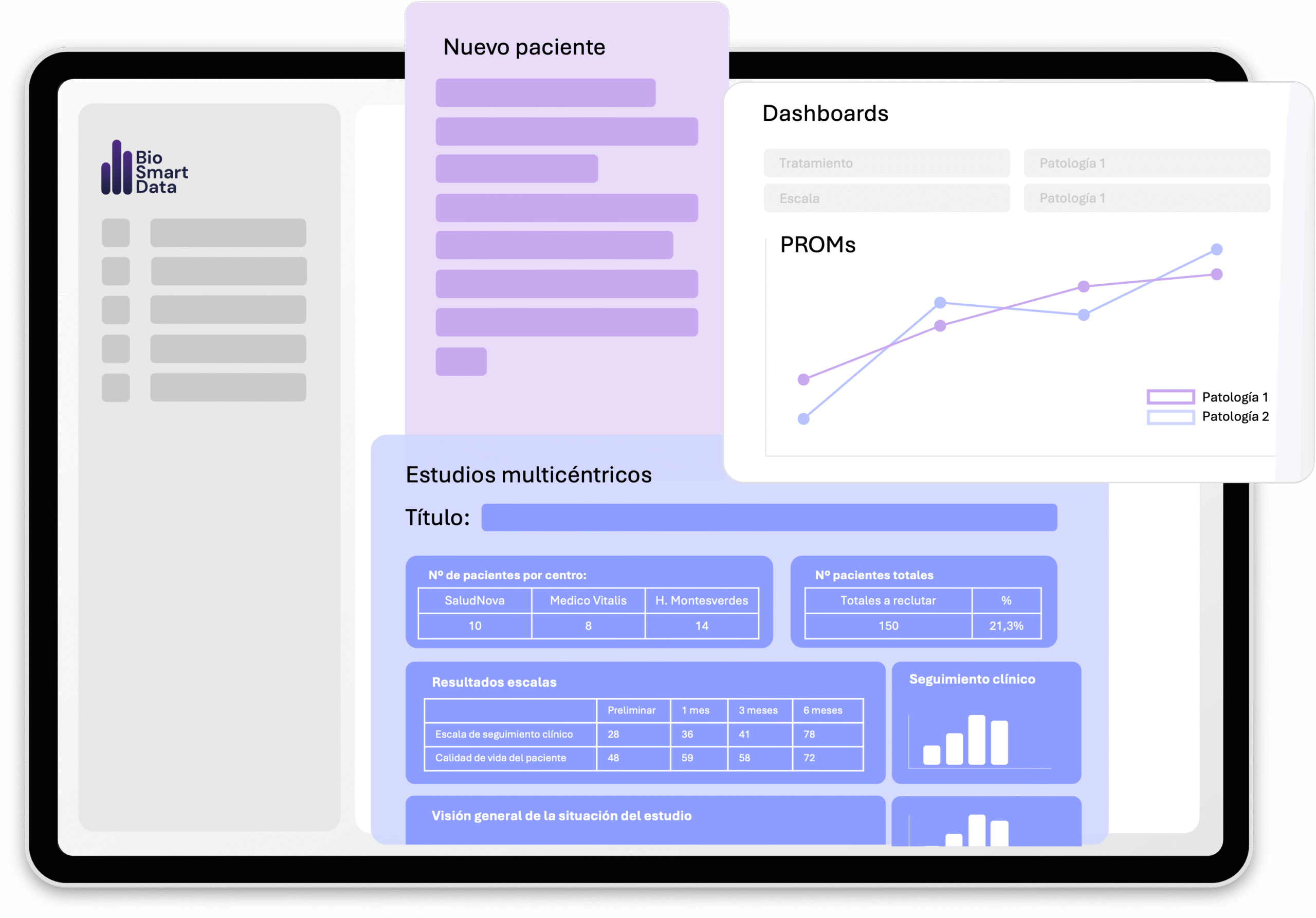
The Technology behind
Powered by Biosmart data technology
- Fully digital eCRD powered by BioSmartData®
- Direct connection to hematology analyzers for PRP classification
- Data encryption, GDPR-compliance & ENS security levels
- AI-powered analysis to identify predictive clinical variables after the study
FAQs
Who can participate?
Any clinical center, hospital or private practice with experience in PRP (Platelet-Rich Plasma) treatments applied to tendon pathologies (patellar, Achilles, epicondylitis, plantar fasciitis). Both public and private institutions are welcome.
What is the cost to participate?
Participation in the study itself is free of charge. Centers only assume the costs associated with acquiring the technology required to operate:
- The BioSmartData® software license
- A compatible hematology analyzer for PRP characterization.
What technology do I need to participate?
- A valid BioSmartData® Software license (cloud-based, easy installation).
- A hematology analyzer capable of PRP parameter analysis (platelet count, WBC, RBC, volume, etc.), compatible with the BioSmartData® system.
- Internet connection to access the platform securely.
How long is the follow-up period for each patient?
Each patient will be monitored for a minimum of 12 months following their PRP treatment, allowing us to collect both short- and mid-term clinical outcomes.
What type of data is collected?
The platform captures structured clinical data directly from your routine practice, including:
- Patient demographics (fully anonymized)
- Clinical diagnosis and tendinopathy location
- PRP preparation parameters and hematology results
- Treatment protocols used
- Functional outcome measures and clinical scales
- Follow-up assessments at predefined timepoints
Who owns the data?
All data is fully anonymized and managed under strict ethical standards. The study database is a collective scientific repository governed by the international research consortium and scientific committee.
Each participating center maintains access to its own cases, and global aggregated data will be used for joint scientific publications.
How is patient data protected?
Patient privacy and data security are top priorities. The platform ensures:
- Full data anonymization
- AES-256 encryption protocols
- GDPR compliance (Europe)
- ENS High Level Security (Spain)
- Controlled access only for authorized research staff